 |
Potential for Discoveries & Findings
Victoria Island is a fascinating region of the arctic, tied in with ancient Inuit cultures, exposed prehistoric animal remains, bizarre findings and links with famous expeditions of early exploration – none more famous than the Franklin Expedition.
Briefly, Captain Sir John Franklin's disappearance in the Arctic in 1848 - along with his two ships and 128 officers and crew that went in search of the ‘Northwest Passage’- was a celebrated mystery in the nineteenth century, attracting enormous public attention. Some forty expeditions were launched in search of his party, and eventually some letters, artefacts and bones were recovered, with evidence of the team resorting to cannibalism, some 80 years later, on King William Island – just to the east of Victoria Island.
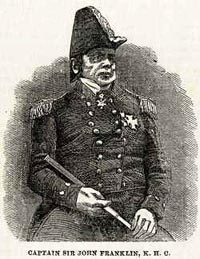 It is now believed that Franklins expedition might have wintered over somewhere along the frozen coastline that we will hike for the first few weeks, and apparently there is a chance we may well stumble upon cairns or artefacts from this famous tragedy that have never before been found. The eastern side of Victoria Island is very remote and isolated, and after the traditional Inuits thousands of years ago, only pockets have been briefly visited. It is now believed that Franklins expedition might have wintered over somewhere along the frozen coastline that we will hike for the first few weeks, and apparently there is a chance we may well stumble upon cairns or artefacts from this famous tragedy that have never before been found. The eastern side of Victoria Island is very remote and isolated, and after the traditional Inuits thousands of years ago, only pockets have been briefly visited.
‘Doug Stern’ who has lived on the island for almost 30yrs has been very generously helping us with information, logistics and enthusiasm – even letting us use his house in Cambridge Bay as a staging platform for our expedition. He is very highly respected on the island for his outdoors knowledge and experience, and internationally – working for Adventure Networks in 2002-3 where he guided people on expeditions to the South Pole. Regarded by locals as a ‘white-Inuit’, everyone points to Doug when seeking information on the island. He is very excited about our expedition and said he can’t think why it hasn’t been done before. He confirmed for us that most of the route we are taking will guide us through land never explored, and he expects us to come upon some amazing discoveries. To highlight just how unknown the islands interior is he told us several bizzare accounts:
A helicopter pilot recently was crossing the island and had to put down for a toilet stop in the middle of the island – landed on a sandy clearing. When he got out he discovered that the ‘clearing’ was the ancient remains of a bowhead whale – unexplainably hundreds of kilometres inland. If we could locate and document these or other remains it could add significant weight to a new theory suggesting that the arctic was inundated by an incredibly large Tsunami thousands of years ago –to my knowledge noting as large as a whale has ever been attached to this theory. Woolly mammoth and other prehistoric remains are even possible finds.
10 yrs ago a kayaking party picked up a skull from a fully-articulated skeleton on the ground - which turned out to be a wood-bison. Wood bison have not been on the island for 8,500 years – back when the climate was different and there were trees…
It is also probable, Doug and Nunavut archaeological experts agree, that we will find stone tent-rings from the ancient Pre-Dorset Inuits (the most ancient of the Inuits on the island), which are built differently to the following Dorset Inuits and later groups. We have been told that whenever we find something of interest, assume that it has never been found before, take photographs, GPS locations etc, as it could well be an important finding.
Most of our expedition is through the unknown, and people who know of the island are very eager to learn of what discoveries we find along the way.
Back to Info Topics
|
|
 |